A year from now, you'll be able to show exactly how your students grew.
Not attendance. Not intentions. Measured evidence of social-emotional development, gathered from your own classrooms.
No commitment, no cost
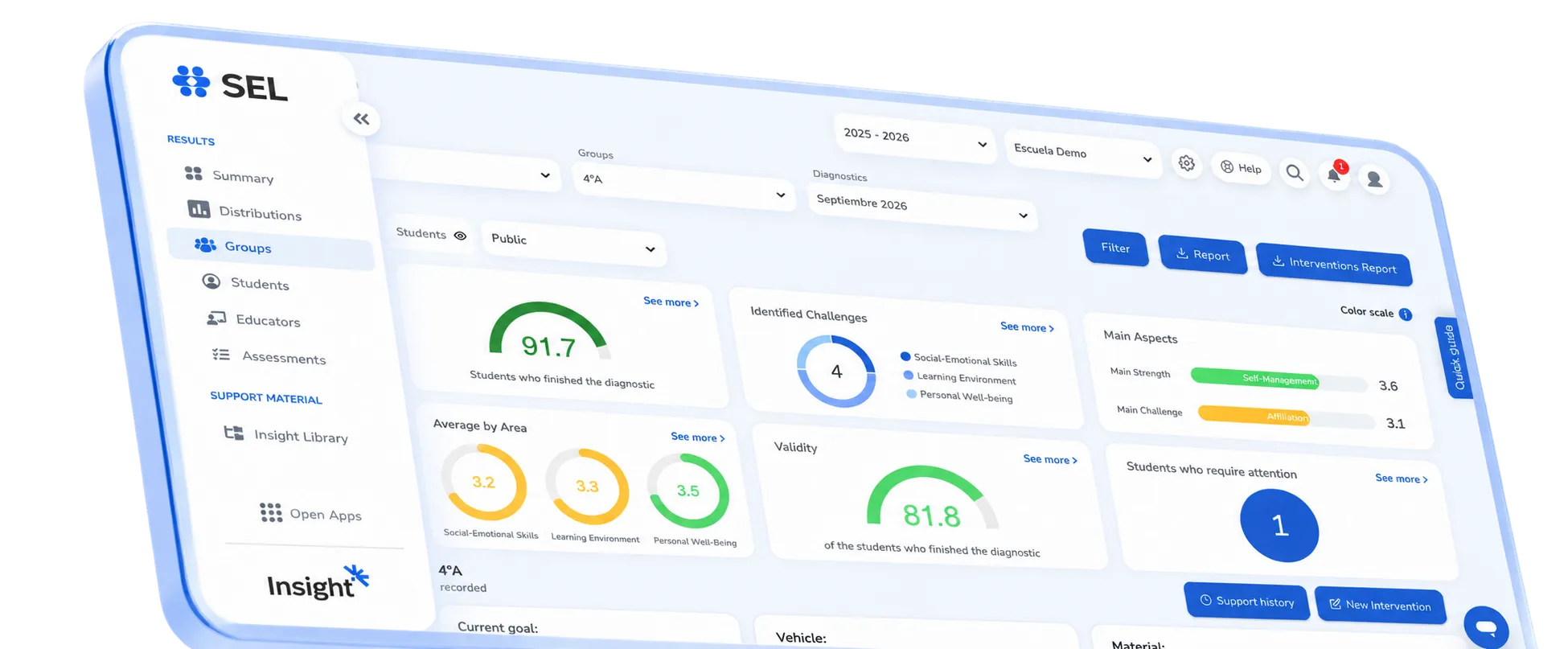
Dashboard
Group comparative view
Responses
Participation

85%
Validity

81%
Identified challenges
See More

9
total challenges
Social Emotional Skills
4
Learning Environment
3
Personal Well-Being
2
Main Aspects
Main Strength

Motivation
4.1
Biggest Challenge

Affiliation
1.6
Average by area


3.6
Social
Emotional Skills

2.5
Learning Environment

1.6
Personal Well-Being
Require attention
See More

11
Students require attention

+13%
Academic performance
Delay gratification segment · one term
+0%
+1%
+2%
+3%
+4%
+5%
+6%
+7%
+8%
+9%
+10%
+11%
+12%




Oct
Feb
May

Self-management

Student–teacher connection

Academic results
Sense of Belonging
Grade 4 · 48 students
2.4
▼ 0.4 since Oct
2.8
2.7
2.6
2.5




Oct 2.8
Feb 2.6
May 2.4
Need range

MarIA drafted this strategy
Sense of Belonging · Group projects
Rotating group roles
Each week, every student owns one visible part of the project — so no one ends up on the edge of the group.
Ready for 4°B · Tuesday
Apply strategy →
Included at year end
Your school ends the year SEL Certified.
Backed by the diagnostic evidence gathered across the year — not by attendance.

Free guide
How to embed SEL into everyday teaching.
A practical guide for schools that already believe in social-emotional learning and want it to happen in real classrooms — not in a separate period once a week. Written from what we've seen work across 1,500 schools.
Inside:
 How SEL shows up in subjects that aren't "about" SEL
- What to look for in a classroom you're already observing
- Where most schools lose momentum in the first term — and how to avoid it
- How to talk about SEL progress with parents
Useful whether or not you ever use Insight.
How it works
How it works, in four steps.
Each one fits into a school day your team already runs — no new platform to learn, no extra period to find.
NEP · 360° View of the Child
See students and educators clearly
Students complete a short diagnostic that surfaces how they're actually doing — belonging, self-management, relationships, frustration tolerance. It takes minutes, not periods, and it doesn't ask teachers to interpret anything.


How easy would it be for you to understand what your friend might be feeling or why they might be acting this way?
A friend suddenly becomes distant and seems irritated, even though they haven’t said anything.
Easy - I could understand their emotions fairly well.

Hard - I might guess, but I’d mostly feed confused.
Neither easy nor hard - I could understand some possible reasons.
Very easy - I could clearly understand their feelings and perspective
Very hard - I wouldn’t understand their feelings at all.




I feel unsure around others.
Stress from schoolwork builds up during the day.
Which of these feels most true for you right now?





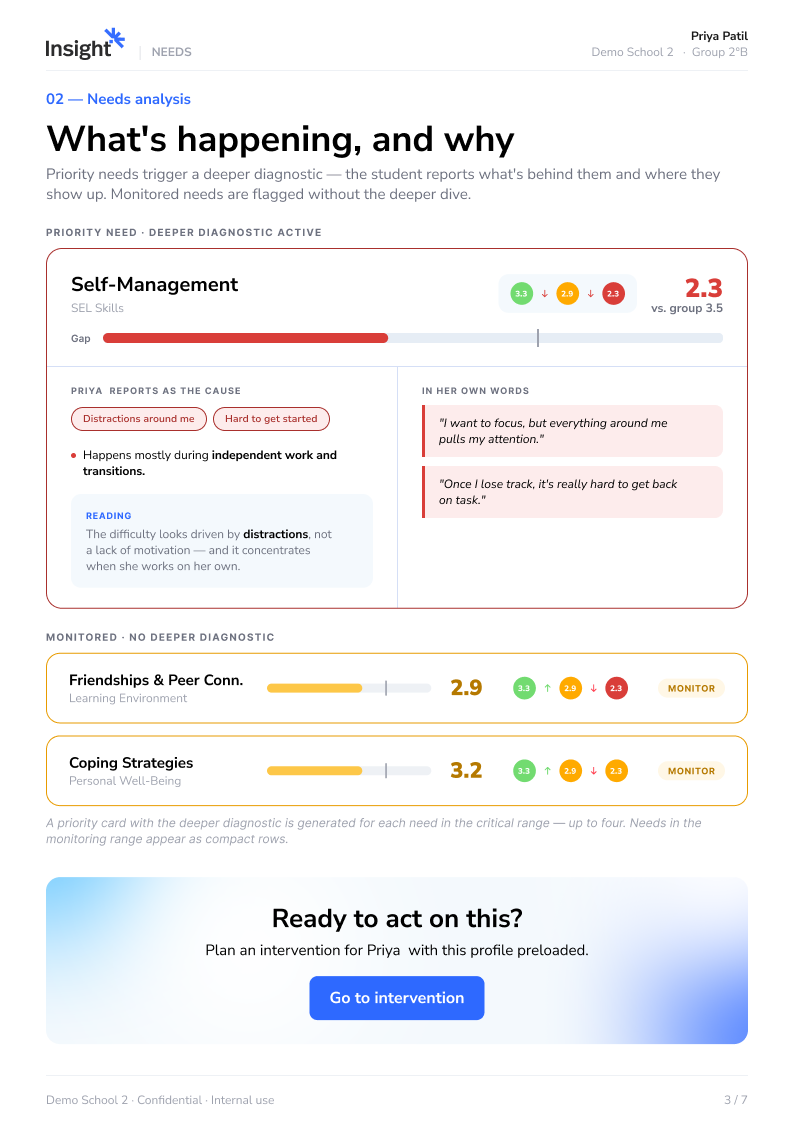
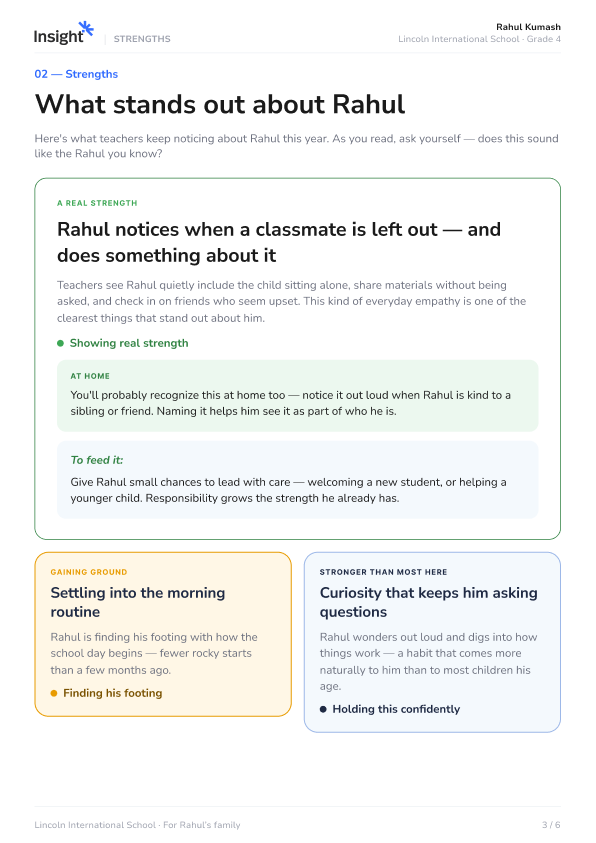
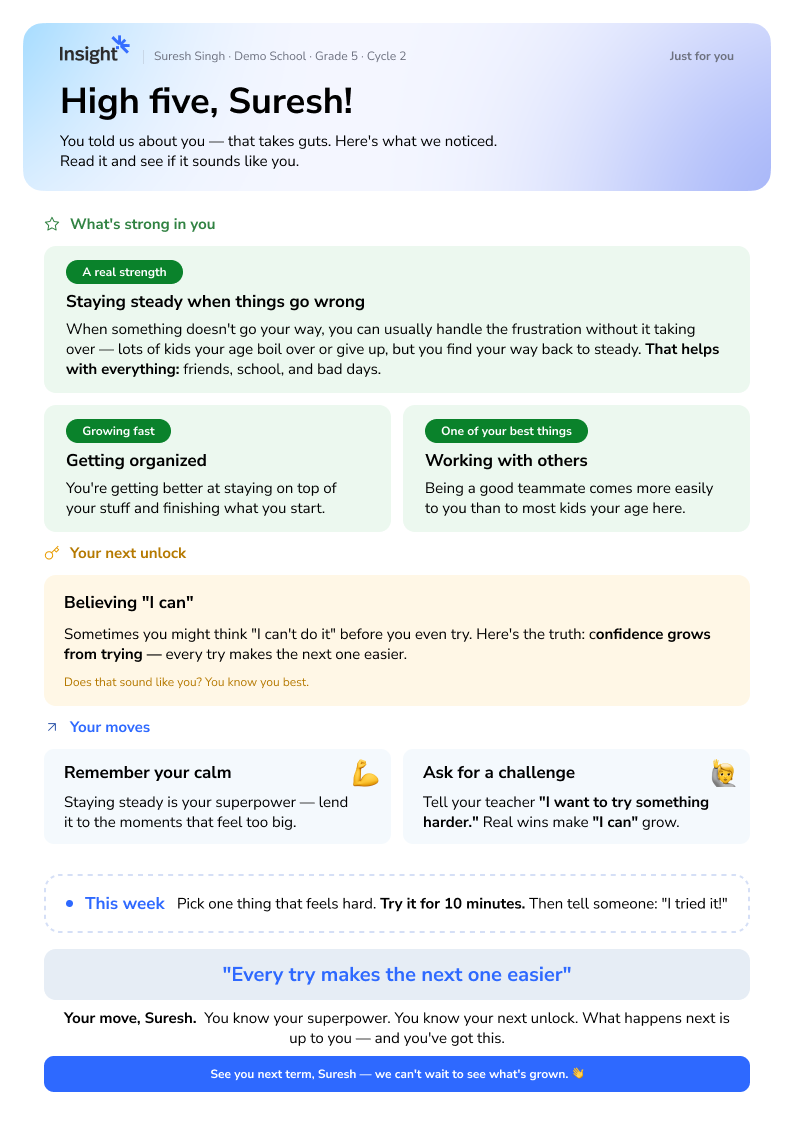




Patterns you can act on.
Across millions of assessments, some findings repeat often enough to change how a school plans. Two examples:
Finding 01
It turns out the best predictor of grades isn't academic at all.
Across millions of Insight assessments, the highest-scoring students share one skill: they can delay gratification.
It holds across grades, schools and countries. So if a school wants better academics, why not start by growing that one skill from first grade?
1
Find who needs the skill
Student list
1° Primaria · sorted by Self-management
Student
Self-mgmt
Grades


James Wilson
2.1
6.2


Emily Thompson
2.3
6.5


Michael Carter
2.4
6.4

Sarah Mitchell
4.2
8.6
2
Group them into a segment
Create segment
Segment name
Delay gratification · 1° Primaria
D
De
Del
Dela
Delay
Delay
Delay g
Delay gr
Delay gra
Delay grat
Delay grati
Delay gratif
Delay gratifi
Delay gratific
Delay gratifica
Delay gratificat
Delay gratificati
Delay gratificatio
Delay gratification
Delay gratification
Delay gratification ·
Delay gratification ·
Delay gratification · 1
Delay gratification · 1°
Delay gratification · 1°
Delay gratification · 1° P
Delay gratification · 1° Pr
Delay gratification · 1° Pri
Delay gratification · 1° Prim
Delay gratification · 1° Prima
Delay gratification · 1° Primar
Delay gratification · 1° Primari
Focus skill
Self-management
JW
ET
MC
Create segment
3
Skill up, results follow
+13%
Academic performance
Delay gratification segment · one term
+0%
+1%
+2%
+3%
+4%
+5%
+6%
+7%
+8%
+9%
+10%
+11%
+12%




Oct
Feb
May

Self-management

Student–teacher connection

Academic results

Counselor




This is the difference between measuring and understanding. A score tells you something is wrong. Insight tells you where it started.
The assessment is the beginning, not the deliverable.
Data that nobody acts on is just another report. What follows the diagnostic is the part that changes a school — and it's built with your team, not handed to them.
Live session · Module 3 of 5
Emotional regulation in the classroom
AP
RK
MS
24 teachers enrolled


Certified Teacher
SEL credential · 2026
Teacher training, built around what your school actually needs.
Training isn't generic SEL professional development. It's shaped by what the diagnostic surfaced in your classrooms — and your teachers earn a Certified Teacher credential that stays with them.

Intervention plan
4°A · 6 students · Emotional regulation
What to try
Name the feeling before reacting
With whom
6 students flagged this cycle
In which setting
Morning circle, Monday to Friday
Intervention plans for the students who need them.
Findings come with specific, practical plans — what to try, with whom, in which setting. Built to run inside lessons and school routines that already exist.
Self-regulation
4°A · this school year
▲
Improving




Oct · 2.1
Assessed
Feb · 2.6
Plan applied
May · 3.2
Re-assessed
Support that continues through the year.
This isn't a one-time diagnostic and a PDF. Assessment, action, and follow-up run across the school year, so you can see whether what you tried actually worked.
Questions schools ask us.
How much time does this take from teachers?

How do we know the results are accurate?
We already measure wellbeing. How is this different?
Does Insight work with our curriculum board?
Does Insight assess teachers too?
Who owns our data, and how is it protected?
What happens after the free trial?
What does it cost?
Schools who use Insight, in their own words.

I am blown away. You have a big fan!

Moshe Bak
Principal, Colegio Or Hajayim

I've never seen a product that is so badly needed on such a wide scale.

Ben Schoenebeck
Hortonville School District
Pure gold.

Grace Gonzalez
School Counselor
1,500+ schools across 9 countries. None have left since we launched.
Read a full school story →Start with your own students.
The trial is real: your students, your classrooms, your results. You'll see what Insight finds and decide from there — nothing automatic, nothing owed.
No commitment, no cost